


A Brief History of Singapore
Singapore’s history traces back to the late 13th century when Sang Nila Utama, a Srivijayan prince from Palembang, is said to have founded the island, naming it Singapura (Lion City) after spotting a creature he believed to be a lion. The island became a strategic trading port due to its prime location along the maritime routes.
By the early 19th century, Singapore had fallen under the influence of the Johor Sultanate. In 1819, Sir Stamford Raffles, an official of the British East India Company, established a British trading post on the island, recognizing its potential as a free port. This marked the beginning of British colonial rule, formalized in 1824 when Singapore became a British possession.
Under British administration, Singapore rapidly grew into a global trading hub, attracting migrants from China, India, and the Malay Archipelago. It became part of the Straits Settlements in 1826 alongside Malacca and Penang.
Singapore’s strategic importance made it a target during World War II, leading to the Japanese occupation from 1942 to 1945. After the war, Singapore returned to British control but sought greater self-governance, eventually becoming a self-governing state in 1959 under Prime Minister Lee Kuan Yew.
In 1963, Singapore joined Malaysia but separated in 1965, becoming an independent republic. Since then, it has transformed into a global financial and technological powerhouse while maintaining its significance as a key maritime hub.
1. Step into History at Fort Canning Park and uncover the secrets of Singapore’s past

Fort Canning Park is a famous hilltop landmark and is renowned for its important role in the Nation’s history. It was the residence of the Javenese prince, Sang Nila Utama. He came from the Majaphahit Empire and named the island Singapura in the Year 1299 (singa-lion, pura-temple). He made himself the King on Singapura. He resided on Fort Canning Hill, which was called the ‘Forbidden Hill’ because commoners were forbade to go up the hill. You can visit the newly opened museum on this history and view the relics of the past 700 years at the Fort Canning Heritage Gallery.

During World War II, under the rule of the British, a secret bunker was built in the hill 1939 as the headquarters for the Far East Command Centre and British Army Barracks, where important military strategies were devised to fight against the Japanese. It was also at this same hill, the Underground Far East Command Centre (now known as the Battle Box (closed for re-tender)), where the British made the painful decision to surrender Singapore to Japan on 15 February 1942. You can visit it, now known as the ‘Battle Box’.
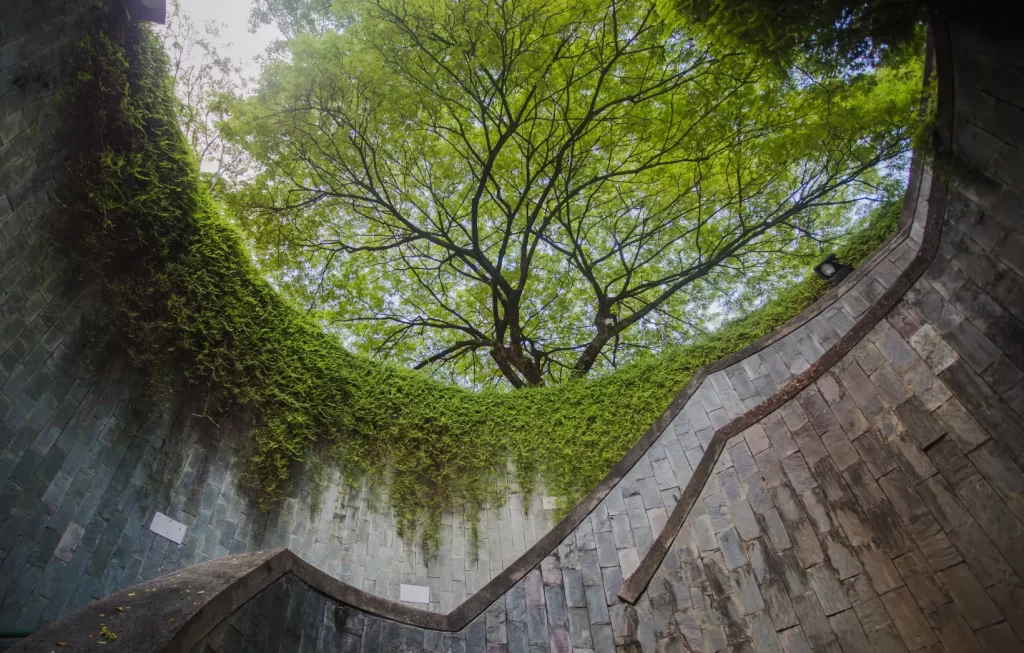
Presently, the Fort Canning Park is also a paradise for garden lovers as it is home to nine magnificent gardens – the Pancur Larangan, Artisan’s Garden, Sang Nila Utama Garden, Jubilee Park, Raffles Garden, First Botanic Garden, Farquhar Garden, Spice Garden, and Armenian Street Park.
Visit the beautiful gardens and immerse yourself in this historical landmark of Singapore! To know more about the Fort Canning Park, visit their official website at: https://www.nparks.gov.sg/gardens-parks-and-nature/parks-and-nature-reserves/fort-canning-park
What: Fort Canning Park
When: opens everyday
Where: Fort Canning Park is bounded by Hill Street, Canning Rise, Clemenceau Avenue and River Valley Road, Singapore 179618
Admission: Free
2. The site of Singapore’s WWII Surrender at the Former Ford Factory
Continue your trip down memory lane and uncover the stories of the Former Ford Factory, a place where history was made in Singapore. Visit the World War Two exhibition presented by the National Archives of Singapore and explore the history of the Ford Motor Company and its involvement in the Malayan Campaign and the Japanese Occupation of Singapore.
What: Former Ford Factory
When: Tuesday to Sunday (9:00am – 5:30pm)
Where: 351 Upper Bukit Timah Road, Singapore 588192
Admission: Admission charges may apply
Visit their official website to know more about the Former Ford Factory: https://corporate.nas.gov.sg/former-ford-factory/visit/tours/
3. Relive the Courageous Journey of WWII Prisoners of War at Changi Museum


Last but not the least, complete your journey to Singapore’s rich history at Changi Chapel and Museum – See over 114 artifacts on display across 8 galleries, including items donated by members of the public, Changi Murals and a replica of the Changi Chapel. Learn more about the suffering and eventual liberation of the prisoners of war (POWs) interned in Changi Prison. This is an ultimate experience that will leave you with a newfound appreciation for the resilience and strength of those who lived through that difficult time.
What: Changi Chapel and Museum
When: Tuesday to Sunday (9.30am to 5.30pm)
Where: 1000 Upper Changi Road North, Singapore 507707
Admission: Admission charges may apply
For more information about the Changi Chapel and Museum, please visit their official website: https://www.nhb.gov.sg/changichapelmuseum/visit/visitor-information
These are just a few highlights among many other incredible historical sites. Whether you are an avid history enthusiast or simply curious about the past, these destinations will surely leave an unforgettable mark on your journey.
Similar Posts


The Sail @ Marina Bay
2 Marina Boulevard
Singapore 018987
-

Phone: +65 6509 0100
-
Whatsapp: +65 8113 9818
-

Email: [email protected]
